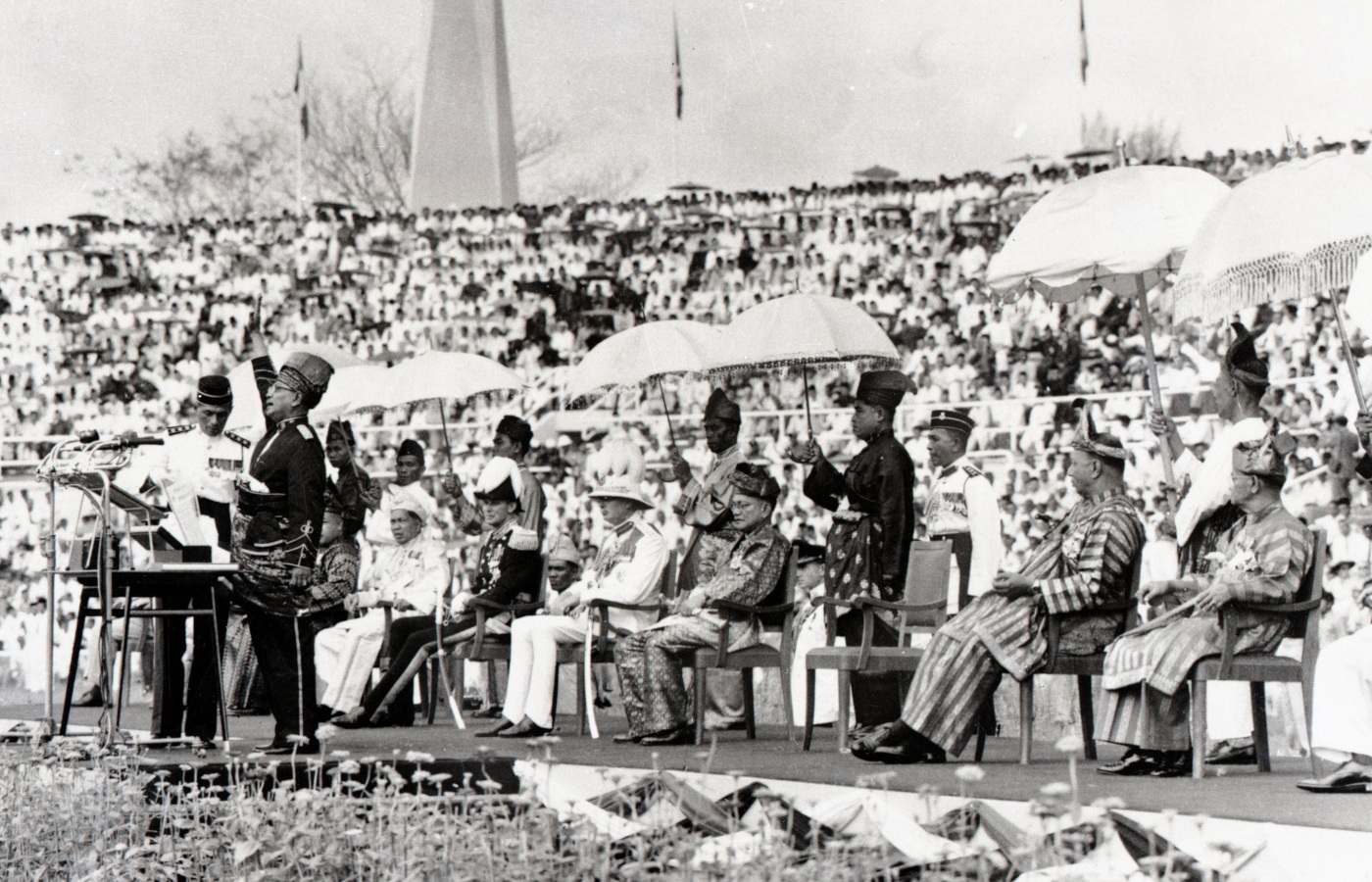
Merdeka
On 31 August 1957 the Federation of Malaya became an independent country. This page examines the independence constitution and later debates about citizenship, language, religion and the special position of the Malays.
Photo: Kerajaan Tanah Melayu · Public domain · Wikimedia Commons
what happened
Independence did not arrive as a single event. Malaya's first federal election, on 27 July 1955, returned the Alliance of UMNO, MCA and MIC in 51 of the 52 elected seats and made Tunku Abdul Rahman Chief Minister. That mandate carried him to London, where on 8 February 1956 an agreement concluded at Lancaster House fixed 31 August 1957 as the date. The British Parliament then passed the Federation of Malaya Independence Act 1957, an Act to establish the Federation "as an independent sovereign country within the Commonwealth." On the day itself, Tunku Abdul Rahman moved from Chief Minister to first Prime Minister, and foreign governments sent representatives — the United States delegation was led by Under Secretary of State Christian A. Herter.
The harder work was the constitution. A commission chaired by Lord Reid was appointed jointly by the Queen and the Malay Rulers, with terms of reference that already named the thing to be balanced: the special position of the Malays and the legitimate interests of other communities. Reid reported in early 1957, and a working party of the Alliance, the Rulers and the British government then revised the draft before enactment.
Four provisions from that document still shape federal argument. Article 3(1) makes Islam the religion of the Federation while providing that other religions may be practised in peace and harmony. Article 152(1) makes Malay the national language, subject to the exceptions in the article itself. Part III sets out the routes to citizenship, including citizenship by operation of law for people born in the Federation. The current Article 153 places on the Yang di-Pertuan Agong the duty of safeguarding the special position of the Malays and natives of Sabah and Sarawak, as well as the legitimate interests of other communities, and provides for reserved proportions in the public service, in scholarships and training, and in certain permits and licences. That current wording incorporates 1963 amendments: the independence constitution was for the Federation of Malaya, and it was subsequently introduced as Malaysia's Federal Constitution on 16 September 1963. Article 153 was not written on a blank page: a special position already appeared in the Federation of Malaya Agreement 1948 and in the Malay State constitutions, and quotas predated Merdeka.
One drafting decision continues to be read in opposite directions. The Reid Commission recommended that the quotas be reviewed after fifteen years, with a report laid before the legislature so it could decide whether to keep, reduce or end them. That review did not survive into the enacted article, which was instead entrenched — amendable only with a two-thirds majority plus the consent of the Conference of Rulers. Abdul Aziz Abdul Rahman treats this as evidence that Article 153 was meant to last. Raja Aziz Addruse and Helen Ting point instead to the Alliance leaders' own request for a fifteen-year review as evidence that they did not intend the provision to be permanent. Joseph Fernando's study frames the choice as a dilemma the framers faced rather than a settled intention.
Around these provisions grew the language of a "social contract". What that phrase denotes is disputed, and so is whether any such contract was agreed at all: Dr Mavis Puthucheary notes the constitution never mentions a social contract, and that the term is used sometimes to mean the inter-ethnic bargain struck by Alliance leaders and sometimes to mean Article 153 specifically, while Dr Syed Husin Ali says the term was not used by those who formulated the constitution. This page therefore does not adopt any single formulation of what was exchanged. After the disturbances of May 1969, the Sedition Act was amended: section 3 defines the relevant tendency and section 4 creates the offences, while section 3(2)(b) separately addresses implementation. For a first-time voter, the constitutional text is public, but both its intended lifespan and the meaning of the social-contract framing remain disputed among historians and lawyers.
the working
What the sources say
established
Parliament records that Tuanku Abdul Rahman of Negeri Sembilan’s first term as Yang di-Pertuan Agong began on 3 August 1957; National Archives material records his oath-taking at Istana Negara on 31 August 1957.
established
Malaya's first federal election was held on 27 July 1955 for the 52 elected seats of the Federal Legislative Council; the Alliance (UMNO, MCA and MIC) won 51 of them, the Pan-Malayan Islamic Party won one, and Tunku Abdul Rahman became Chief Minister.
Bar Council commentary on Alliance history · contemporaneous newsreel record
established
An agreement fixing 31 August 1957 as the date of independence was concluded in London on 8 February 1956 at Lancaster House, between Tunku Abdul Rahman as Chief Minister and Alan Lennox-Boyd, the British Secretary of State for the Colonies, with a Malayan delegation that included Abdul Razak Hussein and Ismail Abdul Rahman.
National Archives of Malaysia · Federation of Malaya Independence Act 1957
established
A constitutional commission chaired by Lord Reid, appointed jointly by the Queen and the Malay Rulers, was given terms of reference that expressly included safeguarding "the special position of the Malays and the legitimate interests of other communities"; it took evidence through 1956 and reported in early 1957.
The Malaysian Bar · Report of the Federation of Malaya Constitutional Commission
established
After the Reid report, a working party made up of representatives of the Alliance, the Malay Rulers and the British government revised the draft before it was enacted.
The Malaysian Bar · Report of the Federation of Malaya Constitutional Commission
established
The United Kingdom Parliament passed the Federation of Malaya Independence Act 1957, whose long title is "An Act to make provision for and in connection with the establishment of the Federation of Malaya as an independent sovereign country within the Commonwealth"; section 1 gave parliamentary approval to the agreement between the Queen and the Rulers of the Malay States for that purpose.
established
Independence took effect on 31 August 1957, when Tunku Abdul Rahman, previously Chief Minister, became the first Prime Minister of the Federation of Malaya.
established
Foreign governments were represented at the independence ceremonies; the United States sent Under Secretary of State Christian A. Herter and Ambassador James P. Richards, and Ismail Abdul Rahman became Malaya's first Ambassador to the United States.
established
Article 3(1) states: "Islam is the religion of the Federation; but other religions may be practised in peace and harmony in any part of the Federation."
Constitution of Malaysia · Federal Constitution (official reprint)
established
Article 152(1) states: "The national language shall be the Malay language and shall be in the script as existing on Merdeka Day," subject to the exceptions set out in the same article.
Constitution of Malaysia · Federal Constitution (official reprint)
established
The constitution created routes to citizenship by operation of law, including for persons born in the Federation, alongside registration and naturalisation routes set out in Part III.
Constitution of Malaysia · Federal Constitution (official reprint)
established
The current Article 153 makes it the responsibility of the Yang di-Pertuan Agong to safeguard the special position of the Malays and natives of any of the States of Sabah and Sarawak, as well as the legitimate interests of other communities, and provides for reservation of a reasonable proportion of positions in the public service, scholarships and training, and certain permits and licences. The official reprint records that the present text was inserted by the 1963 constitutional amendments; the original Merdeka-day text did not refer to Sabah and Sarawak.
Constitution of Malaysia · Federal Constitution (official reprint)
established
The official reprint identifies the document as first introduced as the Constitution of the Federation of Malaya on 31 August 1957 and subsequently introduced as the Federal Constitution of Malaysia on 16 September 1963. Current text and its amendment annotations should therefore not be read as unchanged Merdeka-day text.
established
A "special position" of the Malays was not invented in 1957: it already appeared in the Federation of Malaya Agreement 1948 and in the constitutions of the Malay States, and quota arrangements existed before Merdeka.
The Malaysian Bar · Report of the Federation of Malaya Constitutional Commission
established
The Reid Commission recommended that the Malay quotas under the special-position provision be reviewed after fifteen years, with a report laid before the legislature so it could decide whether to retain, reduce or discontinue them; that review requirement was not carried into the enacted Article 153.
The Malaysian Bar · Report of the Federation of Malaya Constitutional Commission
established
Article 153 is entrenched: amending it requires a two-thirds parliamentary majority and, in addition, the consent of the Conference of Rulers.
established
Section 3(1)(f) of the Sedition Act 1948, as amended in 1971 after the May 1969 disturbances, defines as a seditious tendency a tendency "to question any matter, right, status, position, privilege, sovereignty or prerogative established or protected by" Part III or Articles 152, 153 or 181 of the Federal Constitution. Section 4, not section 3 alone, creates offences for specified acts, words and publications with a seditious tendency. Section 3(2)(b) separately addresses pointing out errors or defects in those protected matters in relation to their implementation.
where accounts differ
The parts nobody agrees on
contested
Whether a "social contract" was actually agreed at Merdeka is disputed. Dr Mavis Puthucheary has said "Nowhere in the Constitution is there any mention of a social contract," and Dr Syed Husin Ali has said the term "was not used by those who formulated the Federal Constitution."
contested
What the term "social contract" refers to is itself unsettled. Dr Mavis Puthucheary has argued it is used sometimes to mean the inter-ethnic bargain struck by Alliance leaders and sometimes to mean Article 153 specifically, and that its definition has tracked the usage of particular political actors.
contested
Whether Article 153 was intended to be temporary or long-lasting is contested. Tan Sri Abdul Aziz Abdul Rahman, writing as legal adviser to the Malay National Consultative Council, argues "It is clear that Article 153 was inserted in the Constitution for it to last a long time," pointing to the rejection of the Reid Commission's fifteen-year review and to the entrenchment requirement. Raja Aziz Addruse, a former Bar Council president, and Helen Ting of IKMAS, UKM, read the same history the other way: because the Alliance leaders themselves asked the Reid Commission for a review of the special position fifteen years after independence, "the Alliance leaders themselves did not intend the provision to be a permanent feature of independent Malaya."
Abdul Aziz Abdul Rahman · Raja Aziz Addruse and Helen Ting · Report of the Federation of Malaya Constitutional Commission
contested
Whether Article 3 makes Malaya/Malaysia a secular or a religious state is contested, and the argument runs back to 1957. The Alliance memorandum to the Reid Commission is quoted as stating that making Islam the religion of the Federation "shall not imply the State is not a secular state." Gan Ping Sieu, then head of the MCA's Political Education Bureau, argues for the secular reading, citing Lord President Mohamed Salleh Abas's 1988 judgment in Che Omar bin Che Soh v Public Prosecutor that "Islam" in Article 3(1) covers only acts relating to rituals and that "the law in this country is... secular law." Tun Abdul Hamid Mohamad, a former Chief Justice of Malaysia, rejects that reading: he notes the Federal Constitution "never once used the word" secular, and says that in Che Omar the word described institutions and laws rather than the country, so "its use is not accurate and the word was used unnecessarily."
Alliance memorandum as quoted in scholarship on constitutional Islam · Gan Ping Sieu · Abdul Hamid Mohamad
uncertain
Why the framers settled on entrenched special rights rather than a time-limited scheme is not established on this page. Joseph M. Fernando's study of the 1956-57 drafting frames the question as a dilemma the framers faced; it is cited here for that framing, not as demonstrating a reason for the choice.
contested
Whether the debate over these provisions can lawfully be held at all is disputed. Lawyer Shaikh Saleem has argued of the social-contract framing that "The scope is being continuously extended that it even prevents any party commenting on the injustices," while section 3(1)(f) of the Sedition Act remains on the statute book.
still being researched
- How the 1957 working party came to remove the fifteen-year review of the Malay quotas: its deliberations are known only through secondary accounts, not from a published working-party record.