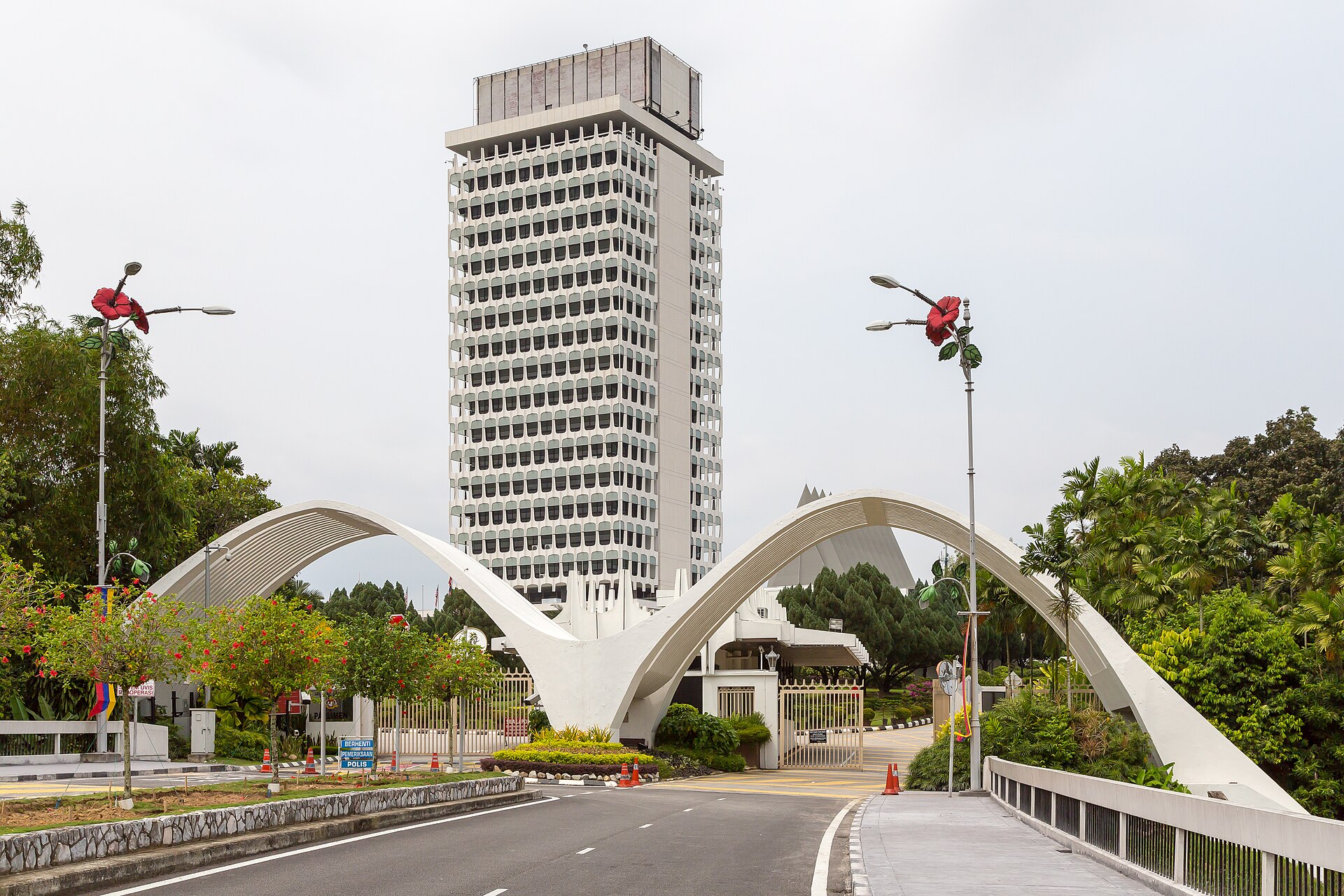
COVID Emergency and Parliament suspension
From 12 January to 1 August 2021 Malaysia was governed under a nationwide Proclamation of Emergency. Elections were not held and laws were made by ordinance instead of by Act; the Dewan Rakyat nevertheless sat from 26 to 29 July 2021.
Photo: CEphoto, Uwe Aranas · CC BY-SA 3.0 · Wikimedia Commons
what happened
On 12 January 2021 the Yang di-Pertuan Agong, Al-Sultan Abdullah, proclaimed a nationwide emergency under Article 150(1) of the Federal Constitution. The palace statement said the Prime Minister, Muhyiddin Yassin, had conveyed the Cabinet's proposal at an audience the previous evening as a step against rising daily COVID-19 cases, that His Majesty considered the situation critical, and that the other Malay Rulers had been consulted. The proclamation was set to run until 1 August 2021 or earlier if the pandemic was contained, an end date that Shad Saleem Faruqi noted was a first for a Malaysian emergency. The same Agong had declined a similar proposal in late October 2020, the palace saying at the time that there was then no need for an emergency and pointing to the Budget sitting due in November.
The practical effect came through the Emergency (Essential Powers) Ordinance 2021, in force from 11 January. It provided that the constitutional rules on summoning, proroguing and dissolving Parliament and the state assemblies would not have effect, so that sittings would resume only on a date the Yang di-Pertuan Agong considered appropriate; general elections, state elections and by-elections were not to be held. The Ordinance also gave members of the armed forces police powers, allowed the commandeering of property, granted good-faith immunity to the government and public officers, and required an independent special committee to advise the Agong on whether the grave emergency continued. That committee, chaired by former Chief Justice Arifin Zakaria, was named on 9 February 2021.
The suspension was disputed from the start. Constitutional lawyers quoted in January 2021 — Lim Wei Jiet, Surendra Ananth and Abdul Aziz Bari — argued variously that democratic practice was suspended, that public health was not a proper ground for emergency, and that the powers lacked checks. Human Rights Watch, through Phil Robertson, called the Ordinance overly broad. Anwar Ibrahim sued the Prime Minister and the Government on 25 January 2021, framing his challenge as directed at the Cabinet's advice to suspend Parliament rather than at the emergency itself.
The government answered on both the political and the legal footing. Muhyiddin said in his televised address of 12 January 2021 that this was not a military coup, that there would be no curfew, that civilian government would continue, and that the extra powers were needed against the pandemic. On 1 March he said no ordinance was aimed at letting a Prime Minister stay in office indefinitely, citing the fixed 1 August end date, the Independent Special Committee of government and opposition MPs and health experts that could advise the Agong to end the emergency early, his undertaking to advise dissolution once the pandemic subsided, and the Agong's 24 February decree that Parliament could in fact reconvene. Takiyuddin Hassan said on 26 April that Parliament would return at a suitable time, before or after 1 August, and that the timing turned on the advice of the Health Ministry and the National Security Council. In court, the Attorney General's Chambers did not argue the merits of section 11 of the Ordinance but non-justiciability: senior federal counsel Ahmad Hanir Hambaly told the High Court on 4 March 2021 that Article 150(6) and 150(8) barred Anwar's application, and in the surviving backbencher challenge senior federal counsel Shamsul Bolhassan argued the case had been overtaken by Parliament's own revocation of the ordinances in October 2021 and by Muhyiddin's resignation.
On the political question of why the emergency was declared, ISEAS analysts Francis E. Hutchinson and Kevin Zhang wrote that it relieved a Prime Minister holding about 111 of 220 seats from having to demonstrate legislative support; Muhyiddin said in March 2021 that the ordinances did not permit indefinite rule.
On 24 February 2021 the palace said Parliament could in fact convene during the emergency, on a date the Agong considered suitable on the advice of the Prime Minister, and that assumptions to the contrary were inaccurate. The Dewan Rakyat finally met in a special sitting from 26 July 2021, after a gap described at the time as around seven months. There, the law minister Takiyuddin Hassan said the emergency ordinances had already been revoked with effect from 21 July and that the emergency would not be extended past 1 August. On 29 July Istana Negara said His Majesty was deeply disappointed, because that revocation had not received his consent and the statement had confused MPs. The sitting had been scheduled for five days, the last of them 2 August, but that final day was postponed indefinitely after COVID-19 cases were detected among parliamentary staff and MPs, so the House rose on 29 July and did not sit again before the emergency lapsed.
The nationwide emergency lapsed on 1 August 2021; a separate Sarawak emergency then took effect on 2 August and was revoked on 3 November. On 16 August Muhyiddin resigned along with his Cabinet, saying he had lost majority support in the Dewan Rakyat, and stayed on as caretaker until a successor was appointed. The ordinances were formally put before the Dewan Rakyat on 25 October 2021, when a motion by Wan Junaidi Tuanku Jaafar to annul them was debated and passed by voice vote; the Dewan Negara passed the resolution on 8 December. Whether the Agong's Article 150 power is exercised on Cabinet advice or in his own discretion remains contested among scholars. In Syed Iskandar's separate case concerning the 2020 refusal to proclaim an emergency, the Court of Appeal upheld on 4 May 2026 the High Court's non-justiciability ruling.
the working
What the sources say
established
Article 150(1) of the Federal Constitution provides that if the Yang di-Pertuan Agong is satisfied that a grave emergency exists whereby the security, or the economic life, or public order in the Federation or any part thereof is threatened, he may issue a Proclamation of Emergency making therein a declaration to that effect.
Article 150(1) as quoted in Exploring the royal prerogative under article 150 of the Malaysian federal constitution · The Monarchy and Article 150
established
Article 150(2B) allows the Yang di-Pertuan Agong to promulgate ordinances having the force of law when a Proclamation of Emergency is in force and the two Houses of Parliament are not sitting concurrently; Article 150(3) provides that a Proclamation and any such ordinance cease to have effect if resolutions annulling them are passed by both Houses.
Article 150(2B) and 150(3) as summarised in Exploring the royal prerogative under article 150 · COVID-19 Response: Proclamation of Emergency by the Yang di-Pertuan Agong
established
A nationwide Proclamation of Emergency was announced on 12 January 2021, following an audience between Prime Minister Muhyiddin Yassin and Yang di-Pertuan Agong Al-Sultan Abdullah Ri'ayatuddin Al-Mustafa Billah Shah at Istana Negara on the evening of 11 January 2021.
Agong declares emergency until 1st August or until COVID-19 situation is under control · Malaysia's King Suspends Parliament for First Time Since 1961 for COVID-19 Emergency
established
The palace statement recorded that the Prime Minister had conveyed the Cabinet's proposal for an emergency proclamation as a step to curb rising daily COVID-19 cases, that His Majesty considered the situation critical and that there was a need to declare an emergency under Clause (1) of Article 150, and that the decision was taken after consulting the other Malay Rulers.
Palace statement as reported in SoyaCincau · Malaysia: King declares COVID-19 state of emergency
established
The emergency was declared to run until 1 August 2021, or earlier if the COVID-19 situation was brought under control — the first Malaysian emergency proclamation to carry an end date of this kind.
Emergency (Essential Powers) Ordinance 2021 gazetted · 2021/132 Reform of Parliament: Lessons from 2020-2021
established
The Emergency (Essential Powers) Ordinance 2021 took effect from 11 January 2021 and was gazetted in mid-January 2021.
Malaysia's Emergency (Essential Powers) Ordinance 2021 in effect from 11 January 2021 · Emergency (Essential Powers) Ordinance 2021 gazetted
established
The Ordinance provided that the constitutional provisions relating to the summoning, proroguing and dissolution of Parliament and of state legislative assemblies should not have effect during the emergency, with sittings to resume on a date the Yang di-Pertuan Agong considered appropriate.
Emergency Ordinance spells out suspension of law-making houses at federal · COVID-19 Response: Proclamation of Emergency by the Yang di-Pertuan Agong
established
General elections, state elections and by-elections were not to be held while the emergency was in force.
Emergency (Essential Powers) Ordinance 2021 gazetted · Malaysia's Declaration of Emergency Keeps PM Muhyiddin's Window Open
established
The Ordinance conferred police powers under the Criminal Procedure Code on members of the armed forces, allowed authorities to commandeer property and resources, and gave the government and public officers immunity from legal proceedings for acts done in good faith in connection with the emergency.
Emergency (Essential Powers) Ordinance 2021 gazetted · Malaysia: Urgently Revise Emergency Ordinance
established
The Ordinance required an independent special committee to advise the Yang di-Pertuan Agong on whether the grave emergency continued to exist.
Emergency (Essential Powers) Ordinance 2021 gazetted · COVID-19 Response: Proclamation of Emergency by the Yang di-Pertuan Agong
established
On 9 February 2021 the government announced the membership of that committee, chaired by former Chief Justice Arifin Zakaria and including former security, health, legal and political figures from both government and opposition benches.
Former chief justice Arifin to head Special Independent Committee on Emergency · Putrajaya announces emergency committee members
established
In late October 2020 the Yang di-Pertuan Agong had declined an earlier proposal by the Prime Minister for an emergency proclamation, the palace stating that His Majesty was of the opinion that there was at that time no need to declare an emergency, and pointing to the Budget 2021 sitting due in November.
Malaysian king rejects Muhyiddin's proposal for emergency declaration · King says no need for state of emergency
established
On 24 February 2021 the palace stated, through the Comptroller of the Royal Household, that Parliament could convene during the emergency on a date the Yang di-Pertuan Agong considered suitable on the advice of the Prime Minister, and that assumptions that the proclamation prevented Parliament from convening were inaccurate.
Agong says Parliament can reconvene during Emergency · The Monarchy and Article 150
established
The Dewan Rakyat next met in a special sitting beginning 26 July 2021, after a gap reported at the time as roughly seven months. It was announced in advance as a five-day sitting: 26, 27, 28 and 29 July and 2 August 2021.
Dewan Rakyat convenes in special meeting on July 26 · Special sitting of Dewan Rakyat set for five days from July 26
established
The Dewan Rakyat sat on 26-29 July 2021, but the final day scheduled for 2 August was postponed indefinitely after COVID-19 cases were detected in Parliament. MPs were informed by the Dewan Rakyat secretary, Nizam Mydin Bacha Mydin, that the health ministry considered Parliament an at-risk location for the spread of COVID-19; the building had been placed under quarantine after 11 people, staff and MPs, tested positive.
established
Health Director-General Noor Hisham Abdullah said on 1 August 2021 that the special sitting was postponed for two weeks with effect from 29 July, after 11 suspected COVID-19 cases were detected during the four-day sitting; further mass screening of 1,183 people found nine more positive cases.
Dr Noor Hisham: Special Parliament sitting postponed for two weeks from July 29
established
On 26 July 2021 the Minister in the Prime Minister's Department in charge of law, Takiyuddin Hassan, told the Dewan Rakyat that the emergency ordinances had been revoked with effect from 21 July 2021 and that the government would not advise the Yang di-Pertuan Agong to extend the emergency beyond 1 August 2021.
All emergency ordinances revoked on July 21 · Emergency Ordinances revoked on July 21
established
On 29 July 2021 Istana Negara issued a statement through the Comptroller of the Royal Household, Ahmad Fadil Shamsuddin, saying His Majesty was deeply disappointed at the 26 July statement in Parliament that the ordinances had been repealed when the revocation had not received his consent, and that the announcement had confused MPs.
Palace says Agong yet to consent to revocation of emergency ordinances · Shouts of 'resign
established
The nationwide emergency lapsed on 1 August 2021; a separate Sarawak emergency took effect on 2 August and was revoked on 3 November 2021. On 16 August 2021 Muhyiddin Yassin tendered the resignation of himself and his Cabinet to the Yang di-Pertuan Agong, saying he had lost majority support in the Dewan Rakyat; he remained as caretaker Prime Minister pending a successor.
Proclamation of Emergency (Sarawak) (Revocation) 2021 · Malaysia's Prime Minister Muhyiddin Yassin and cabinet resign · Caretaker Prime Minister in Malaysia
established
On 25 October 2021, under the successor government, a motion tabled by Minister in the Prime Minister's Department (Parliament and Law) Wan Junaidi Tuanku Jaafar to annul the emergency ordinances was debated and passed by voice vote in the Dewan Rakyat. The Dewan Negara unanimously passed the resolution on 8 December 2021.
Emergency Ordinances annulled by voice vote in Dewan Rakyat on Monday (Oct 25) · Dewan Rakyat approves motion to repeal Emergency Ordinances · Dewan Negara lulus usul ungkai tujuh ordinan darurat
established
Seven Emergency Ordinances were listed in Parliament’s October 2021 motion to annul them; the earlier figure of six referred to the ordinances in force before the later seventh instrument was included.
adjudicated
Anwar Ibrahim’s judicial-review application of 25 January 2021 was dismissed by the High Court, and the Court of Appeal later dismissed the appeal by Anwar and other applicants, holding that the proclamation and related challenge could not be reviewed because of Article 150(8).
uncertain
The 2021 Ordinance required an independent special committee to advise the Yang di-Pertuan Agong on whether the emergency continued, but no public record of its formal advice or recommendation has been located.
searched: Emergency (Essential Powers) Ordinance material, government statements, and Parliament records
where accounts differ
The parts nobody agrees on
contested
Whether the emergency was necessary for public health reasons is contested. The government's stated basis, recorded in the palace statement and the Prime Minister's announcement, was the record rise in daily COVID-19 cases; ISEAS analysts Francis E. Hutchinson and Kevin Zhang wrote on 18 January 2021 that sceptics questioned the need, since existing infectious disease legislation and movement control orders already conferred substantial powers.
Malaysia's Declaration of Emergency Keeps PM Muhyiddin's Window Open · palace statement as reported in SoyaCincau
contested
Whether the emergency's political effect was to shield a government with a narrow majority is contested. Hutchinson and Zhang argued the suspension relieved Muhyiddin, who held about 111 of 220 seats and faced defection pressure from UMNO, of the need to demonstrate legislative support; the government maintained the measure was a pandemic response, and Muhyiddin said in March 2021 that the ordinances did not permit indefinite rule by the Prime Minister.
ISEAS · Muhyiddin: Emergency ordinances do not allow indefinite rule of PM
contested
Whether suspending Parliament by ordinance was constitutional is contested. Constitutional lawyer Lim Wei Jiet said democracy was practically suspended for as long as the emergency lasted; lawyer Surendra Ananth argued that suspending Parliament contradicts the Constitution and that public health is not a ground for an emergency; constitutional scholar Abdul Aziz Bari said the powers were very wide and not subject to checks and balances.
contested
The government's own defence of the suspension was made on four grounds. First, on the day of the proclamation, 12 January 2021, Prime Minister Muhyiddin Yassin said in a televised address that the proclamation was not a military coup, that no curfew would be imposed, that the civilian government would continue to function, and that the government needed the additional powers to fight the worsening pandemic.
Muhyiddin: Emergency not military coup · Emergency not a military coup
contested
Second, on 1 March 2021 Muhyiddin argued that the arrangement was time-limited and supervised rather than open-ended: "I am aware and I understand the meaning of democracy. Therefore, not a single ordinance is aimed at allowing the Prime Minister to remain in power forever." He pointed to the fixed 1 August 2021 end date, to the Independent Special Committee of government and opposition MPs and health experts empowered to advise the Yang di-Pertuan Agong that the emergency could end earlier, to his undertaking to advise dissolution once the pandemic subsided, and to the Agong's decree of 24 February 2021 that Parliament could reconvene during the emergency — which, he said, meant the assumption that the proclamation prevented Parliament from convening was inaccurate.
Muhyiddin: Emergency ordinances do not allow indefinite rule of PM
contested
Third, on the question of why Parliament in fact did not sit, the Minister in the Prime Minister's Department in charge of parliament and law, Takiyuddin Hassan, said on 26 April 2021 that Parliament would reconvene "at a suitable time, either before or after the state of emergency is lifted on Aug 1," that the current focus was on addressing the COVID-19 pandemic, and that the timing depended on the advice of the Health Ministry, the National Security Council and other expert bodies.
contested
Fourth, the government's formal legal position in court has been that the challenge is not one the courts may entertain. Opposing Anwar Ibrahim's judicial review — which sought to invalidate section 11 of the Emergency (Essential Powers) Ordinance 2021, the provision suspending Parliament, and the Cabinet advice behind it — senior federal counsel Ahmad Hanir Hambaly, with SFC S. Narkunavathy and federal counsel Mohammad Sallehuddin Md Ali, told the Kuala Lumpur High Court on 4 March 2021 that the application was barred by Article 150(6) and Article 150(8) of the Federal Constitution. In the later challenge to the same section 11 advice brought by government backbenchers, senior federal counsel Shamsul Bolhassan, appearing for the government and for Muhyiddin, argued that the case had been overtaken by events because Parliament itself had debated and revoked the ordinances on 25 October 2021 and because mandatory orders against a Prime Minister who resigned on 16 August 2021 were no longer possible. The AGC did not argue that the suspension itself was substantively constitutional.
Emergency proclamation: AGC objects to Anwar's bid for judicial review · Court to rule on Muhyiddin's 2021 advice to suspend Parliament
contested
Whether the Agong's Article 150 powers are exercised on Cabinet advice or in his own discretion is contested among constitutional scholars. Shad Saleem Faruqi wrote in August 2021 that Article 150(1) must be read with Article 40(1), which requires the King to act on Cabinet advice, and that case law including Teh Cheng Poh supports this, while others rely on Article 40(2) to argue the power is discretionary.
alleged
Anwar Ibrahim filed suit in the Kuala Lumpur High Court on 25 January 2021 against Muhyiddin Yassin and the Government of Malaysia, seeking declarations that the Cabinet's advice to promulgate the section of the Ordinance suspending Parliament was unlawful and unconstitutional; he stated he was challenging the advice rather than the emergency itself.
Anwar sues PM over Parliament suspension in Emergency · High Court asks Anwar's lawyers to submit whether state of emergency referral questions will be heard first
adjudicated
In a separate case brought by lawyer Syed Iskandar Syed Jaafar Al Mahdzar over the 2020 refusal to proclaim an emergency, High Court judge Wan Ahmad Farid Wan Salleh held in February 2024 that the Yang di-Pertuan Agong's power to proclaim an emergency under Article 150 is not justiciable by the court, and that Article 150(8) does not violate the basic structure of the Constitution. The Court of Appeal upheld that ruling on 4 May 2026.
Judge: Agong's power to proclaim emergency not justiciable by court · Appellate Court dismisses appeal over King's refusal to declare emergency
contested
Human Rights Watch, in a statement by deputy Asia director Phil Robertson on 21 January 2021, described the Ordinance as overly broad, objecting to the grant of police powers to the armed forces, the good-faith immunity clause, property seizure without challenge to compensation, and the suspension of elections without a stated end date.
contested
Whether the 21 July 2021 revocation of the ordinances was legally effective was disputed at the time. The palace statement of 29 July said the revocation had not received royal consent; the government subsequently said in early August that the revocation process was incomplete and could be debated in Parliament, and the annulment motion was ultimately put to the Dewan Rakyat only on 25 October 2021.
MalaysiaNow · PM: Emergency ordinances revocation incomplete · The Star